Thu, Oct 22, 2026


Volume 14, Issue 3 (9-2026)
J. Pediatr. Rev 2026, 14(3): 301-308 |
Back to browse issues page



Download citation:
BibTeX | RIS | EndNote | Medlars | ProCite | Reference Manager | RefWorks
Send citation to:


BibTeX | RIS | EndNote | Medlars | ProCite | Reference Manager | RefWorks
Send citation to:
Hokmabadi S, Jalali H, Amirzadegan M, Mahdavi M R. CFTR Variant Analysis of Patients With Cystic Fibrosis in Mazandaran Province, North of Iran. J. Pediatr. Rev 2026; 14 (3) :301-308
URL: http://jpr.mazums.ac.ir/article-1-823-en.html
URL: http://jpr.mazums.ac.ir/article-1-823-en.html


1- Department of Pediatrics, Bou Ali Sina Hospital, Mazandaran University of Medical Sciences, Sari, Iran.
2- Thalassemia Research Center, Hemoglobinopathies Institute, Mazandaran University of Medical Sciences, Sari, Iran.
3- Sinaye Mehr Research Center, Mazandaran University of Medical Sciences Sari,Iran.
4- Thalassemia Research Center, Hemoglobinopathies Institute, Mazandaran University of Medical Sciences, Sari, Iran. ,Mahdavi899@gmail.com
2- Thalassemia Research Center, Hemoglobinopathies Institute, Mazandaran University of Medical Sciences, Sari, Iran.
3- Sinaye Mehr Research Center, Mazandaran University of Medical Sciences Sari,Iran.
4- Thalassemia Research Center, Hemoglobinopathies Institute, Mazandaran University of Medical Sciences, Sari, Iran. ,
Keywords: Cystic fibrosis (CF), Cystic fibrosis transmembrane conductance regulator (CFTR) gene, Whole exome sequencing, Pathogenic variants, Iran
Full-Text [PDF 383 kb]
(110 Downloads)
| Abstract (HTML) (313 Views)
Full-Text: (65 Views)
Introduction:
Cystic fibrosis (CF) is a monogenic disorder with autosomal recessive inheritance, primarily affecting people of Northern European ancestry [1]. First described in 1949, this common life-limiting disease arises from deleterious variants in the CF transmembrane conductance regulator (CFTR) gene on chromosome 7 [2, 3]. More than 72,000 cases of CF have been reported worldwide [4], and the frequency of the disease varies significantly among different ethnic groups, with the highest incidence observed in individuals of Caucasian descent [5]. In contrast, CF is extremely rare in Japan, with an estimated incidence of approximately one in every 350,000 live births [6]. In Europe, the incidence ranges widely from 1 in 97,000 in Latvia to 1 in 3,400 in Ireland, highlighting notable regional differences in prevalence [7]. According to the American Cystic Fibrosis Foundation Patient Registry (CFFPR), more than 40,000 individuals are currently diagnosed with CF in the United States [8]. More than 75% of individuals with CF are diagnosed by age 2, although the mean age at diagnosis is around 3 years [1].
The CFTR gene, located at chromosomal position 7q31.2, comprises 27 exons and encodes the CFTR protein. This protein functions as a chloride ion channel in epithelial cell membranes, playing a critical role in maintaining fluid balance across tissues. Pathogenic variants in the CFTR gene disrupt the protein’s structure or function, leading to impaired ion transport and the clinical manifestations of CF [9-11]. Over 2,000 unique mutations in the CFTR gene have been reported, according to the Cystic Fibrosis Mutation Database, underscoring the genetic heterogeneity of CF [12]. Globally, the ΔF508 mutation represents the most common pathogenic variant in the CFTR gene, with an estimated frequency of about 70% among individuals diagnosed with CF [13]. Previous research has indicated that ΔF508 is among the most common CFTR mutations in the Iranian population. However, the overall mutation spectrum in Iran is highly heterogeneous, with numerous distinct variants contributing to CF cases across different regions and ethnic groups [14].
Iran, located in the Middle East, has a population of over 92 million with significant ethnic diversity. The majority of the population comprises Persians, followed by Azerbaijanis, Kurds, Lurs, Balochs, Arabs, Turkmens, and other ethnic groups, each contributing to the country’s complex social fabric and regional identities [15, 16]. Previous studies on thalassemia and deafness [17-19] have demonstrated a gradient shift in mutation types and frequencies, moving from northwest to southeast parts. This suggests that the northwestern Iranian population is more similar to Turkish and East Europeans compared to the south and southeast populations. Because of this ethnic diversity, some genetic disorders are far more common in specific areas. For example, thalassemia is more common in the North (especially Mazandaran Province) and the South of Iran [20, 21].
The purpose of this study was to characterize the molecular spectrum of CF in Mazandaran Province, north of Iran. By identifying the types and frequencies of CFTR gene mutations in this region, we aim to improve understanding of the regional genetic profile of CF, contribute to genotype–phenotype correlation data, and support the development of more accurate diagnostic, screening, and genetic counseling strategies tailored to the local population.
Materials and Methods
Participants were 17 patients clinically diagnosed with CF referred to the CF center at Boali Sina Children’s Hospital in Mazandaran Province. CF diagnosis was established by specialists based on elevated sweat chloride concentrations (>60 mEq/L) measured on two separate occasions using the pilocarpine iontophoresis method, in accordance with clinical guidelines, and the presence of characteristic clinical manifestations, including recurrent or persistent respiratory symptoms (chronic cough, dyspnea, sputum production) and/or gastrointestinal features (malabsorption, chronic diarrhea, failure to thrive).
Demographic and clinical variables, including age at diagnosis, sex, family history, consanguinity, and primary clinical manifestations, were first recorded for all participants. Peripheral venous blood samples (3–5 mL) were collected in EDTA-containing tubes. Genomic DNA was extracted from leukocytes using the phenol–chloroform method following standard laboratory protocols. DNA concentration and purity were assessed using spectrophotometry and agarose gel electrophoresis to ensure suitability for downstream analyses.
Fourteen patients were initially screened for known CFTR pathogenic variants using a polymerase chain reaction (PCR)–Sanger sequencing approach. Mutation-specific primers previously described in the literature [17] were employed. Target exons were amplified in a 25 µL reaction containing 100 ng genomic DNA, 10 pmol of each primer, and 2× PCR Master Mix (Amplicon, Denmark). PCR amplification was performed with an initial denaturation at 95 °C for 5 minutes, followed by 35 cycles of denaturation at 95 °C for 30 seconds, annealing at 60 °C for 45 seconds, and extension at 72 °C for 1 minute, with a final extension at 72 °C for 7 minutes. Amplified products were visualized on a 1% agarose gel and subsequently purified for bidirectional Sanger sequencing using the Applied Biosystems 3130xl Genetic Analyzer. Sequence chromatograms were analyzed against the CFTR reference sequence (NM_000492.4) to identify pathogenic variants.
Whole exome sequencing (WES) was performed for three patients to identify rare or novel CFTR variants. Genomic DNA was fragmented, and exonic regions were captured using a commercial exome enrichment kit, followed by library preparation with indexed adaptors. Libraries were sequenced on an Illumina platform using paired-end 150 bp reads, targeting a mean coverage depth of ≥100×, with >85% of bases achieving a Phred quality Q score ≥30. Raw reads were aligned to the human reference genome (GRCh38, NM_000492.4) using the BWA tool, and duplicates were marked with Picard. Variant calling was performed using the Genome Analysis Toolkit following best-practice workflows, and variants were annotated and filtered based on minor allele frequency (<1%), predicting functional impact, and known clinical significance in ClinVar and CFTR-specific databases. Candidate CFTR variants were confirmed by PCR–Sanger sequencing, and pathogenic variants were classified according to ACMG/AMP guidelines before inclusion in the study analysis.
Results
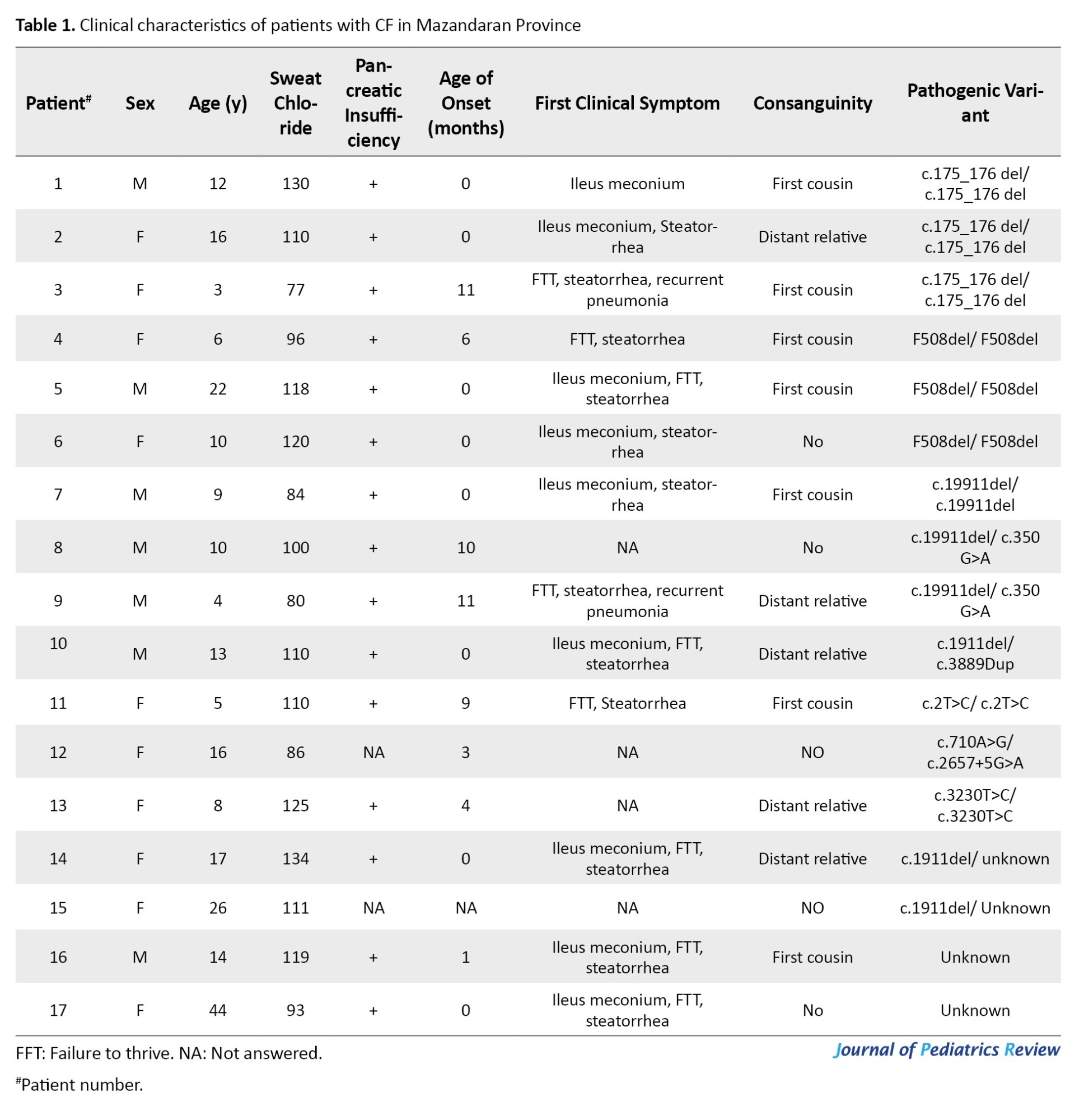
A total of 17 patients with CF from unrelated families of Mazandarani origin were included in this study, comprising 7 males and 10 females, aged 3-44 years. Pathogenic variants were identified on both alleles in 13 out of 17 patients. In two patients, a single heterozygous mutation was detected, while no mutation was found in the remaining two patients. Among the 13 patients with biallelic mutations, 9 were homozygous and 4 were compound heterozygous (Table 1).
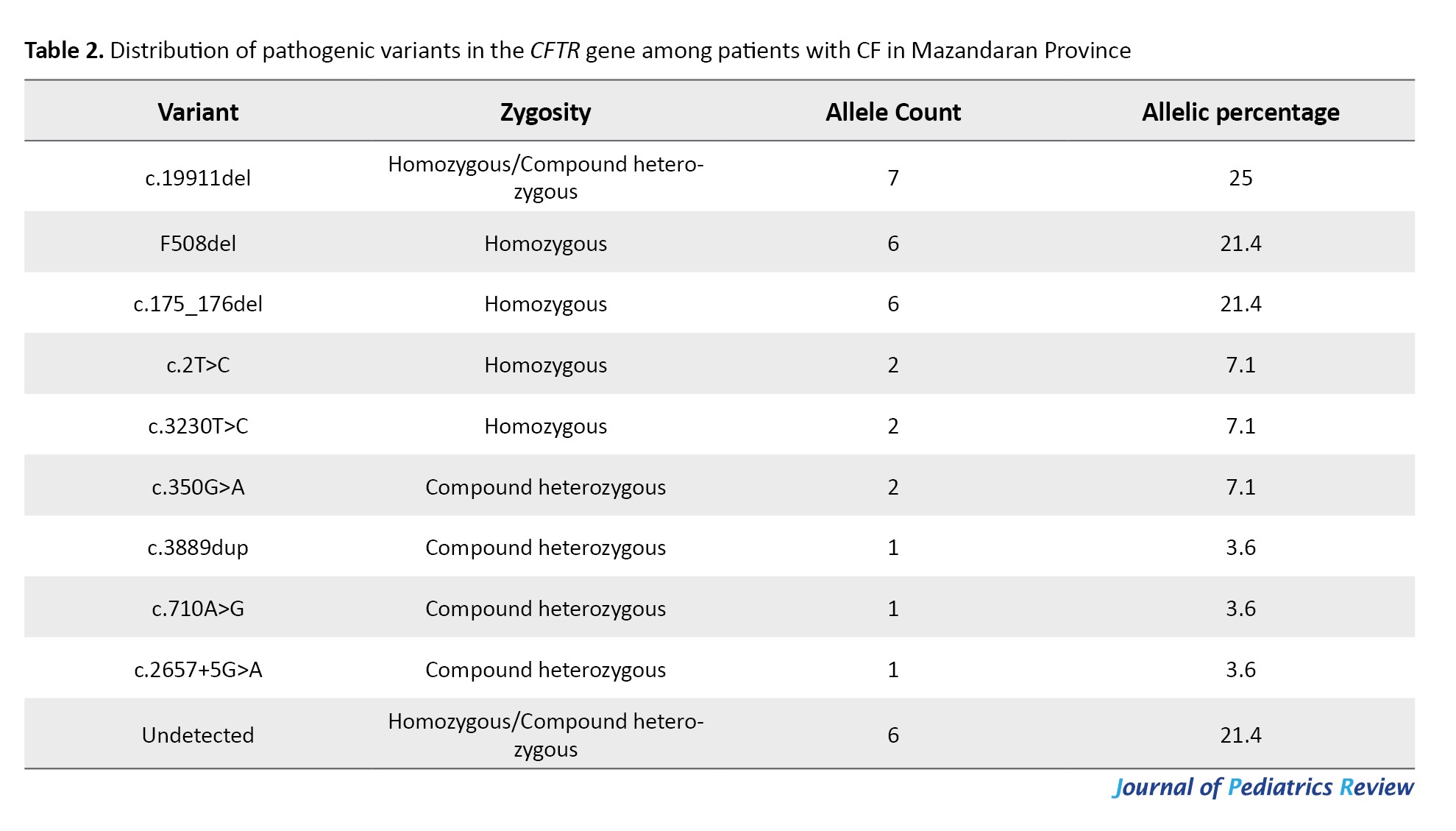
A total of nine distinct pathogenic variants were identified across the patients, encompassing 28 mutant alleles. The most frequent variant was c.19911del, accounting for 25% of all alleles. The F508del and c.175_176del variants were each detected in three homozygous patients, representing the second most common variants with an allelic frequency of 21.4%. The c.2T>C and c.3230T>C variants were each identified in one patient in the homozygous state. The c.350G>A variant was observed in two patients as part of a compound heterozygous genotype with c.19911del. Additionally, the c.3889dup, c.710A>G, and c.2657+5G>A variants were each detected in a single allele as part of a compound heterozygous genotype (Table 2).
Discussion
Most studies on the identification and prevalence of CFTR variants have mostly been conducted in European and American countries [22], with limited research available in other countries, including Iran, which is home to approximately 1% of the global population, making it the second most populous nation in the Middle East [23, 24]. It has been located on the historic Silk Road route and has witnessed several waves of migration as a result of various historical events, which brings attention to the valuable genetic insights embedded in the Iranian population [25]. Iran’s population is composed of diverse ethnic groups, each with its own dialects, languages, and religious beliefs. Recent research reveals that the Iranian population exhibits high genetic diversity while maintaining distinct genetic characteristics [26]. The present study investigated the distribution of CFTR mutations in CF patients from Mazandaran Province, a region situated in northern Iran on the southern shore of the Caspian Sea.
To date, a total of 101 distinct CFTR gene variants have been reported among Iranian patients with CF. The most prevalent variant is p.Phe508del (c.1521_1523delCTT), accounting for 21.22% of cases [14]. In the present study, 9 different CFTR variants were identified in CF patients. The c.19911del variant was the most common, followed by the p.Phe508del and c.175_176del variants. Although the frequency of the F508del variant in our study is consistent with previous reports in Iran [27], it remains lower than the rates reported in most Western European countries (~60%), and significantly below those in Albania (81.4%), Croatia (81.3%), and Denmark (81.4%) [28]. In Iran, approximately 54% of F508del alleles are found in patients from the northwest and western regions bordering Turkey. In contrast, in Mazandaran Province, F508del was the second most common variant after c.19911del. This regional variation may reflect genetic heterogeneity across different parts of Iran [26], as well as the unique genetic continuity of populations in the Northern Iranian Plateau, as previously reported [29]. A study on 56 CF patients from Northeastern Iran investigated the frequency of common CFTR mutations using ARMS-PCR, PCR-RFLP, and PCR-sequencing of exons 11 and 12. Among 112 alleles, 24 mutations (21.42%) were detected, with c.1521_1523delCTT (p.Phe508del) being the most prevalent (10.71%), followed by c.1677delTA (p.Tyr559Ter) and c.1397C>G (p.Ser466Ter) each with 3.57% prevalence, while c.3909C>G (p.Asn1303Lys), c.1624G>T (p.Gly542Ter), c.1030C>T (p.Arg344Trp), and c.1400C>T (p.Leu467Phe) were rare (each with 0.89% prevalence) [30]. These findings highlight the regional spectrum of CFTR mutations in Iran, emphasizing the importance of population-specific genetic screening for accurate diagnosis and genetic counseling.
Establishing a robust genotype–phenotype correlation in CF patients is crucial for advancing personalized medicine, improving prognostic accuracy, and guiding therapeutic decisions. Different CFTR mutations can lead to different clinical manifestations, ranging from classic CF with severe pulmonary and pancreatic involvement to milder or atypical CF. Understanding how specific genetic variants influence disease severity, organ involvement, and response to CFTR modulators enables clinicians to tailor treatment strategies more effectively. Moreover, genotype–phenotype insights are essential for genetic counseling, early diagnosis through newborn screening, and the development of mutation-specific therapies, particularly in populations with diverse or regionally unique mutation spectra.
The findings from Mazandaran Province in our study highlight a distinct CFTR mutational spectrum shaped by founder effects and high consanguinity. Future studies in neighboring provinces such as Guilan and Golestan can be useful for regional comparisons, helping to map population-specific allele frequencies and identify shared or unique variants. Such data can improve genetic counseling, early diagnosis, and targeted carrier screening programs across northern Iran. Moreover, larger, multi-province analyses can clarify genotype–phenotype correlations, reveal potential founder mutations, and guide personalized treatment strategies, including emerging CFTR-modulator therapies. Ultimately, these efforts will contribute to a comprehensive understanding of CF in the Iranian population and inform public health initiatives tailored to local needs.
There were some limitations in this study. The relatively small sample size limited to a single province may limit the generalizability of the findings to other regions of Iran. Two patients showed no detectable CFTR mutations, which may reflect technical limitations of the detection method, including the inability to identify deep intronic variants, large rearrangements, or regulatory region mutations. The absence of comprehensive functional analyses also limits interpretation of rare variants, particularly c.19911del. Additionally, undiagnosed mild or atypical cases cannot be excluded, potentially affecting the representation of the regional mutation spectrum. Larger, multicenter studies using comprehensive sequencing approaches are recommended to validate and expand these findings.
Conclusion
In Mazandaran Province, northern Iran, our analyses revealed a distinct spectrum of CFTR variants, reflecting both genetic heterogeneity and a likely founder effect. The c.1991del variant is the most prevalent mutation in this region, surpassing the globally dominant p.Phe508del (ΔF508), which was the second most common variant in the region. These findings underscore the importance of region-specific genetic screening and contribute to a broader understanding of CF in the Iranian population.
Ethical Considerations
Compliance with ethical guidelines
This study was approved by the Ethics Committee of Mazandaran University of Medical Sciences, Sari, Iran (Code: IR.MAZUMS.REC.1403.343). Written informed consent was obtained from the participants or their parents following a counseling session regarding the implications of genetic testing for CF.
Funding
This research was supported by the research project, Funded by Mazandaran University of Medical Sciences, Sari, Iran (Project No.: 14372).
Authors contributions
All authors equally contributed to preparing this article.
Conflicts of interest
The authors declared no conflict of interest.
Acknowledgements
The authors gratefully acknowledge the staff of Fajr Medical Laboratory for their help and support.
Cystic fibrosis (CF) is a monogenic disorder with autosomal recessive inheritance, primarily affecting people of Northern European ancestry [1]. First described in 1949, this common life-limiting disease arises from deleterious variants in the CF transmembrane conductance regulator (CFTR) gene on chromosome 7 [2, 3]. More than 72,000 cases of CF have been reported worldwide [4], and the frequency of the disease varies significantly among different ethnic groups, with the highest incidence observed in individuals of Caucasian descent [5]. In contrast, CF is extremely rare in Japan, with an estimated incidence of approximately one in every 350,000 live births [6]. In Europe, the incidence ranges widely from 1 in 97,000 in Latvia to 1 in 3,400 in Ireland, highlighting notable regional differences in prevalence [7]. According to the American Cystic Fibrosis Foundation Patient Registry (CFFPR), more than 40,000 individuals are currently diagnosed with CF in the United States [8]. More than 75% of individuals with CF are diagnosed by age 2, although the mean age at diagnosis is around 3 years [1].
The CFTR gene, located at chromosomal position 7q31.2, comprises 27 exons and encodes the CFTR protein. This protein functions as a chloride ion channel in epithelial cell membranes, playing a critical role in maintaining fluid balance across tissues. Pathogenic variants in the CFTR gene disrupt the protein’s structure or function, leading to impaired ion transport and the clinical manifestations of CF [9-11]. Over 2,000 unique mutations in the CFTR gene have been reported, according to the Cystic Fibrosis Mutation Database, underscoring the genetic heterogeneity of CF [12]. Globally, the ΔF508 mutation represents the most common pathogenic variant in the CFTR gene, with an estimated frequency of about 70% among individuals diagnosed with CF [13]. Previous research has indicated that ΔF508 is among the most common CFTR mutations in the Iranian population. However, the overall mutation spectrum in Iran is highly heterogeneous, with numerous distinct variants contributing to CF cases across different regions and ethnic groups [14].
Iran, located in the Middle East, has a population of over 92 million with significant ethnic diversity. The majority of the population comprises Persians, followed by Azerbaijanis, Kurds, Lurs, Balochs, Arabs, Turkmens, and other ethnic groups, each contributing to the country’s complex social fabric and regional identities [15, 16]. Previous studies on thalassemia and deafness [17-19] have demonstrated a gradient shift in mutation types and frequencies, moving from northwest to southeast parts. This suggests that the northwestern Iranian population is more similar to Turkish and East Europeans compared to the south and southeast populations. Because of this ethnic diversity, some genetic disorders are far more common in specific areas. For example, thalassemia is more common in the North (especially Mazandaran Province) and the South of Iran [20, 21].
The purpose of this study was to characterize the molecular spectrum of CF in Mazandaran Province, north of Iran. By identifying the types and frequencies of CFTR gene mutations in this region, we aim to improve understanding of the regional genetic profile of CF, contribute to genotype–phenotype correlation data, and support the development of more accurate diagnostic, screening, and genetic counseling strategies tailored to the local population.
Materials and Methods
Participants were 17 patients clinically diagnosed with CF referred to the CF center at Boali Sina Children’s Hospital in Mazandaran Province. CF diagnosis was established by specialists based on elevated sweat chloride concentrations (>60 mEq/L) measured on two separate occasions using the pilocarpine iontophoresis method, in accordance with clinical guidelines, and the presence of characteristic clinical manifestations, including recurrent or persistent respiratory symptoms (chronic cough, dyspnea, sputum production) and/or gastrointestinal features (malabsorption, chronic diarrhea, failure to thrive).
Demographic and clinical variables, including age at diagnosis, sex, family history, consanguinity, and primary clinical manifestations, were first recorded for all participants. Peripheral venous blood samples (3–5 mL) were collected in EDTA-containing tubes. Genomic DNA was extracted from leukocytes using the phenol–chloroform method following standard laboratory protocols. DNA concentration and purity were assessed using spectrophotometry and agarose gel electrophoresis to ensure suitability for downstream analyses.
Fourteen patients were initially screened for known CFTR pathogenic variants using a polymerase chain reaction (PCR)–Sanger sequencing approach. Mutation-specific primers previously described in the literature [17] were employed. Target exons were amplified in a 25 µL reaction containing 100 ng genomic DNA, 10 pmol of each primer, and 2× PCR Master Mix (Amplicon, Denmark). PCR amplification was performed with an initial denaturation at 95 °C for 5 minutes, followed by 35 cycles of denaturation at 95 °C for 30 seconds, annealing at 60 °C for 45 seconds, and extension at 72 °C for 1 minute, with a final extension at 72 °C for 7 minutes. Amplified products were visualized on a 1% agarose gel and subsequently purified for bidirectional Sanger sequencing using the Applied Biosystems 3130xl Genetic Analyzer. Sequence chromatograms were analyzed against the CFTR reference sequence (NM_000492.4) to identify pathogenic variants.
Whole exome sequencing (WES) was performed for three patients to identify rare or novel CFTR variants. Genomic DNA was fragmented, and exonic regions were captured using a commercial exome enrichment kit, followed by library preparation with indexed adaptors. Libraries were sequenced on an Illumina platform using paired-end 150 bp reads, targeting a mean coverage depth of ≥100×, with >85% of bases achieving a Phred quality Q score ≥30. Raw reads were aligned to the human reference genome (GRCh38, NM_000492.4) using the BWA tool, and duplicates were marked with Picard. Variant calling was performed using the Genome Analysis Toolkit following best-practice workflows, and variants were annotated and filtered based on minor allele frequency (<1%), predicting functional impact, and known clinical significance in ClinVar and CFTR-specific databases. Candidate CFTR variants were confirmed by PCR–Sanger sequencing, and pathogenic variants were classified according to ACMG/AMP guidelines before inclusion in the study analysis.
Results
A total of 17 patients with CF from unrelated families of Mazandarani origin were included in this study, comprising 7 males and 10 females, aged 3-44 years. Pathogenic variants were identified on both alleles in 13 out of 17 patients. In two patients, a single heterozygous mutation was detected, while no mutation was found in the remaining two patients. Among the 13 patients with biallelic mutations, 9 were homozygous and 4 were compound heterozygous (Table 1).
A total of nine distinct pathogenic variants were identified across the patients, encompassing 28 mutant alleles. The most frequent variant was c.19911del, accounting for 25% of all alleles. The F508del and c.175_176del variants were each detected in three homozygous patients, representing the second most common variants with an allelic frequency of 21.4%. The c.2T>C and c.3230T>C variants were each identified in one patient in the homozygous state. The c.350G>A variant was observed in two patients as part of a compound heterozygous genotype with c.19911del. Additionally, the c.3889dup, c.710A>G, and c.2657+5G>A variants were each detected in a single allele as part of a compound heterozygous genotype (Table 2).
Discussion
Most studies on the identification and prevalence of CFTR variants have mostly been conducted in European and American countries [22], with limited research available in other countries, including Iran, which is home to approximately 1% of the global population, making it the second most populous nation in the Middle East [23, 24]. It has been located on the historic Silk Road route and has witnessed several waves of migration as a result of various historical events, which brings attention to the valuable genetic insights embedded in the Iranian population [25]. Iran’s population is composed of diverse ethnic groups, each with its own dialects, languages, and religious beliefs. Recent research reveals that the Iranian population exhibits high genetic diversity while maintaining distinct genetic characteristics [26]. The present study investigated the distribution of CFTR mutations in CF patients from Mazandaran Province, a region situated in northern Iran on the southern shore of the Caspian Sea.
To date, a total of 101 distinct CFTR gene variants have been reported among Iranian patients with CF. The most prevalent variant is p.Phe508del (c.1521_1523delCTT), accounting for 21.22% of cases [14]. In the present study, 9 different CFTR variants were identified in CF patients. The c.19911del variant was the most common, followed by the p.Phe508del and c.175_176del variants. Although the frequency of the F508del variant in our study is consistent with previous reports in Iran [27], it remains lower than the rates reported in most Western European countries (~60%), and significantly below those in Albania (81.4%), Croatia (81.3%), and Denmark (81.4%) [28]. In Iran, approximately 54% of F508del alleles are found in patients from the northwest and western regions bordering Turkey. In contrast, in Mazandaran Province, F508del was the second most common variant after c.19911del. This regional variation may reflect genetic heterogeneity across different parts of Iran [26], as well as the unique genetic continuity of populations in the Northern Iranian Plateau, as previously reported [29]. A study on 56 CF patients from Northeastern Iran investigated the frequency of common CFTR mutations using ARMS-PCR, PCR-RFLP, and PCR-sequencing of exons 11 and 12. Among 112 alleles, 24 mutations (21.42%) were detected, with c.1521_1523delCTT (p.Phe508del) being the most prevalent (10.71%), followed by c.1677delTA (p.Tyr559Ter) and c.1397C>G (p.Ser466Ter) each with 3.57% prevalence, while c.3909C>G (p.Asn1303Lys), c.1624G>T (p.Gly542Ter), c.1030C>T (p.Arg344Trp), and c.1400C>T (p.Leu467Phe) were rare (each with 0.89% prevalence) [30]. These findings highlight the regional spectrum of CFTR mutations in Iran, emphasizing the importance of population-specific genetic screening for accurate diagnosis and genetic counseling.
Establishing a robust genotype–phenotype correlation in CF patients is crucial for advancing personalized medicine, improving prognostic accuracy, and guiding therapeutic decisions. Different CFTR mutations can lead to different clinical manifestations, ranging from classic CF with severe pulmonary and pancreatic involvement to milder or atypical CF. Understanding how specific genetic variants influence disease severity, organ involvement, and response to CFTR modulators enables clinicians to tailor treatment strategies more effectively. Moreover, genotype–phenotype insights are essential for genetic counseling, early diagnosis through newborn screening, and the development of mutation-specific therapies, particularly in populations with diverse or regionally unique mutation spectra.
The findings from Mazandaran Province in our study highlight a distinct CFTR mutational spectrum shaped by founder effects and high consanguinity. Future studies in neighboring provinces such as Guilan and Golestan can be useful for regional comparisons, helping to map population-specific allele frequencies and identify shared or unique variants. Such data can improve genetic counseling, early diagnosis, and targeted carrier screening programs across northern Iran. Moreover, larger, multi-province analyses can clarify genotype–phenotype correlations, reveal potential founder mutations, and guide personalized treatment strategies, including emerging CFTR-modulator therapies. Ultimately, these efforts will contribute to a comprehensive understanding of CF in the Iranian population and inform public health initiatives tailored to local needs.
There were some limitations in this study. The relatively small sample size limited to a single province may limit the generalizability of the findings to other regions of Iran. Two patients showed no detectable CFTR mutations, which may reflect technical limitations of the detection method, including the inability to identify deep intronic variants, large rearrangements, or regulatory region mutations. The absence of comprehensive functional analyses also limits interpretation of rare variants, particularly c.19911del. Additionally, undiagnosed mild or atypical cases cannot be excluded, potentially affecting the representation of the regional mutation spectrum. Larger, multicenter studies using comprehensive sequencing approaches are recommended to validate and expand these findings.
Conclusion
In Mazandaran Province, northern Iran, our analyses revealed a distinct spectrum of CFTR variants, reflecting both genetic heterogeneity and a likely founder effect. The c.1991del variant is the most prevalent mutation in this region, surpassing the globally dominant p.Phe508del (ΔF508), which was the second most common variant in the region. These findings underscore the importance of region-specific genetic screening and contribute to a broader understanding of CF in the Iranian population.
Ethical Considerations
Compliance with ethical guidelines
This study was approved by the Ethics Committee of Mazandaran University of Medical Sciences, Sari, Iran (Code: IR.MAZUMS.REC.1403.343). Written informed consent was obtained from the participants or their parents following a counseling session regarding the implications of genetic testing for CF.
Funding
This research was supported by the research project, Funded by Mazandaran University of Medical Sciences, Sari, Iran (Project No.: 14372).
Authors contributions
All authors equally contributed to preparing this article.
Conflicts of interest
The authors declared no conflict of interest.
Acknowledgements
The authors gratefully acknowledge the staff of Fajr Medical Laboratory for their help and support.
References:
- Chen Q, Shen Y, Zheng J. A review of cystic fibrosis: Basic and clinical aspects. Animal Model Exp Med. 2021; 4(3):220-32. [DOI:10.1002/ame2.12180] [PMID]
- Ratjen F, Bell SC, Rowe SM, Goss CH, Quittner AL, Bush A. Cystic fibrosis. Nat Rev Dis Primers. 2015; 1:15010. [DOI:10.1038/nrdp.2015.10] [PMID]
- Pérez-Frías J, Pérez Ruiz E, López Castillo MDC, Caro García P. The history of cystic fibrosis. Open J Pediatr Child Health. 2019; 4(1):1–6. [DOI:10.17352/ojpch.000015]
- Jackson AD, Goss CH. Epidemiology of CF: How registries can be used to advance our understanding of the CF population. J Cyst Fibros. 2018; 17(3):297-305. [DOI:10.1016/j.jcf.2017.11.013] [PMID]
- Cutting GR. Modifier genetics: Cystic fibrosis. Annu Rev Genomics Hum Genet. 2005; 6:237-60. [DOI:10.1146/annurev.genom.6.080604.162254] [PMID]
- Yamashiro Y, Shimizu T, Oguchi S, Shioya T, Nagata S, Ohtsuka Y. The estimated incidence of cystic fibrosis in Japan. J Pediatr Gastroenterol Nutr. 1997; 24(5):544-7. [DOI:10.1097/00005176-199705000-00010] [PMID]
- Farrell PM, White TB, Ren CL, Hempstead SE, Accurso F, Derichs N, et al. Diagnosis of cystic fibrosis: Consensus guidelines from the cystic fibrosis foundation. J Pediatr. 2017; 181S:S4-S15.e1. [DOI:10.1016/j.jpeds.2016.09.064] [PMID]
- Cromwell EA, Ostrenga JS, Todd JV, Elbert A, Brown AW, Faro A, et al. Cystic fibrosis prevalence in the United States and participation in the Cystic Fibrosis Foundation Patient Registry in 2020. J Cyst Fibros. 2023; 22(3):436-42. [DOI:10.1016/j.jcf.2023.02.009] [PMID]
- Lucarelli M, Bruno SM, Pierandrei S, Ferraguti G, Stamato A, Narzi F, et al. A genotypic-oriented view of CFTR genetics highlights specific mutational patterns underlying clinical macrocategories of cystic fibrosis. Mol Med. 2015; 21(1):257-75. [DOI:10.2119/molmed.2014.00229] [PMID]
- Davies JC, Alton EW, Bush A. Cystic fibrosis. BMJ. 2007 Dec; 335(7632):1255-9. [DOI:10.1136/bmj.39391.713229.AD] [PMID]
- Lukasiak A, Zajac M. The distribution and role of the CFTR protein in the intracellular Compartments. Membranes (Basel). 2021; 11(11):804. [DOI:10.3390/membranes11110804] [PMID]
- De Boeck K, Amaral MD. Progress in therapies for cystic fibrosis. Lancet Respir Med. 2016; 4(8):662-74. [DOI:10.1016/S2213-2600(16)00023-0] [PMID]
- Rafique H, Safdar A, Ghani MU, Akbar A, Awan FI, Naeem Z, et al. Exploring the diversity of CFTR gene mutations in cystic fibrosis individuals of South Asia. J Asthma. 2024; 61(6):511-9. [DOI:10.1080/02770903.2023.2297365] [PMID]
- Alibakhshi R, Mohammadi A, Khamooshian S, Kazeminia M, Moradi K. CFTR gene mutation spectrum among 735 Iranian patients with cystic fibrosis: A comprehensive systematic review. Pediatr Pulmonol. 2021; 56(12):3644-56. [DOI:10.1002/ppul.25647] [PMID]
- Danaei G, Farzadfar F, Kelishadi R, Rashidian A, Rouhani OM, Ahmadnia S, et al. Iran in transition. Lancet. 2019; 393(10184):1984-2005. [DOI:10.1016/S0140-6736(18)33197-0] [PMID]
- Alicata C, Ashouri E, Nemat-Gorgani N, Guethlein LA, Marin WM, Tao S, et al. KIR variation in Iranians combines high haplotype and allotype diversity with an abundance of functional inhibitory receptors. Front Immunol. 2020; 11:556. [DOI:10.3389/fimmu.2020.00556] [PMID]
- Mahdieh N, Rabbani B, Wiley S, Akbari MT, Zeinali S. Genetic causes of nonsyndromic hearing loss in Iran in comparison with other populations. J Hum Genet. 2010; 55(10):639-48. [DOI:10.1038/jhg.2010.96] [PMID]
- Rezaee AR, Banoei MM, Khalili E, Houshmand M. Beta-thalassemia in Iran: New insight into the role of genetic admixture and migration. ScientificWorldJournal. 2012; 2012:635183. [DOI:10.1100/2012/635183] [PMID]
- Valaei A, Karimipoor M, Kordafshari A, Zeinali S. Molecular Basis of α-Thalassemia in Iran. Iran Biomed J. 2018; 22(1):6-14. [PMID]
- Jalali H, Mahdavi MR, Roshan P, Kosaryan M, Karami H, Mahdavi M. Alpha thalassemia gene mutations in neonates from Mazandaran, Iran, 2012. Hematology. 2014; 19(4):192-5. [DOI:10.1179/1607845413Y.0000000115] [PMID]
- Sheikhi K, Vahed SN, Pordanjani SR, Momenabadi V, Khazaei Z, Azizi M, et al. Epidemiology of the incidence, prevalence, and mortality of thalassemia in Iran: A secondary analysis of global burden of disease 2019. Health Sci Rep. 2025; 8(8):e71129. [DOI:10.1002/hsr2.71129] [PMID]
- Castellani C, Cuppens H, Macek M Jr, Cassiman JJ, Kerem E, Durie P, et al. Consensus on the use and interpretation of cystic fibrosis mutation analysis in clinical practice. J Cyst Fibros. 2008; 7(3):179-96. [DOI:10.1016/j.jcf.2008.03.009] [PMID]
- Mirzaei H, Zhaleh AB, Ahmadnezhad E, Gohrimehr M, Abdalmaleki E, Alvandi R, et al. Health status in the Islamic Republic of Iran, Middle East and North Africa countries: Implications for global health. Iran J Public Health. 2020; 49(1): 86. [DOI:10.18502/ijph.v49i1.3055]
- Dunnen JT, Antonarakis SE. Mutation nomenclature extensions and suggestions to describe complex mutations: A discussion. Hum Mutat. 2000; 15(1):7-12. [DOI:10.1002/(SICI)1098-1004(200001)15:1%3C7::AID-HUMU4%3E3.0.CO;2-N]
- Fattahi Z, Beheshtian M, Mohseni M, Poustchi H, Sellars E, Nezhadi SH, et al. Iranome: A catalog of genomic variations in the Iranian population. Hum Mutat. 2019; 40(11):1968-84. [DOI:10.1002/humu.23880] [PMID]
- Mehrjoo Z, Fattahi Z, Beheshtian M, Mohseni M, Poustchi H, Ardalani F, et al. Distinct genetic variation and heterogeneity of the Iranian population. PLoS Genet. 2019; 15(9):e1008385. [DOI:10.1371/journal.pgen.1008385] [PMID]
- Alibakhshi R, Kianishirazi R, Cassiman JJ, Zamani M, Cuppens H. Analysis of the CFTR gene in Iranian cystic fibrosis patients: identification of eight novel mutations. J Cyst Fibros. 2008; 7(2):102-9. [DOI:10.1016/j.jcf.2007.06.001] [PMID]
- Hatziagorou E, Orenti A, Drevinek P, Kashirskaya N, Mei-Zahav M, De Boeck K; ECFSPR. Electronic address: ECFS-Patient.Registry@uz.kuleuven.ac.be; ECFSPR. Changing epidemiology of the respiratory bacteriology of patients with cystic fibrosis-data from the European cystic fibrosis society patient registry. J Cyst Fibros. 2020; 19(3):376-83. [DOI:10.1016/j.jcf.2019.08.006] [PMID]
- Amjadi MA, Özdemir YC, Ramezani M, Jakab K, Megyes M, Bibak A, et al. Ancient DNA indicates 3,000 years of genetic continuity in the Northern Iranian Plateau, from the copper age to the Sassanid Empire. Sci Rep. 2025; 15(1):16530. [DOI:10.1038/s41598-025-99743-w] [PMID]
- Mehdizadeh Hakkak A, Keramatipour M, Talebi S, Brook A, Tavakol Afshari J, Raazi A, et al. Analysis of CFTR gene mutations in children with cystic fibrosis, First Report from North-East of Iran. Iran J Basic Med Sci. 2013; 16(8):917-21. [PMID]
Type of Study: Original Article |
Subject:
Pulmonology
Received: 2025/11/10 | Accepted: 2026/09/19 | Published: 2026/09/19
Received: 2025/11/10 | Accepted: 2026/09/19 | Published: 2026/09/19
Send email to the article author
| Rights and permissions | |
 |
This work is licensed under a Creative Commons Attribution-NonCommercial 4.0 International License. |

Copyright © The Author(s);
This is an open access article distributed under the terms of the Creative Commons Attribution License (CC-By-NC),
which permits use, distribution, and reproduction in any medium, provided the original work is properly cited and is not used for commercial purposes.
Contact Information