Tue, Oct 20, 2026


Volume 14, Issue 3 (9-2026)
J. Pediatr. Rev 2026, 14(3): 223-230 |
Back to browse issues page



Download citation:
BibTeX | RIS | EndNote | Medlars | ProCite | Reference Manager | RefWorks
Send citation to:


BibTeX | RIS | EndNote | Medlars | ProCite | Reference Manager | RefWorks
Send citation to:
Putri A M R Y. Primary Closure Versus Staged Silo Closure in Neonatal Gastroschisis: A Narrative Review. J. Pediatr. Rev 2026; 14 (3) :223-230
URL: http://jpr.mazums.ac.ir/article-1-829-en.html
URL: http://jpr.mazums.ac.ir/article-1-829-en.html


Emergency Department, Lanto Daeng Pasewang Hospital, Jeneponto, Indonesia. , mataharirezkya.yp@gmail.com
Full-Text [PDF 353 kb]
(130 Downloads)
| Abstract (HTML) (274 Views)
Full-Text: (67 Views)
Introduction
Gastroschisis is a birth abnormality that affects the front of the abdomen and causes the intestines and other abdominal contents to push through a paraumbilical aperture without a protective barrier. The defect is usually on the right side of the umbilicus, which exposes the colon to amniotic fluid. This causes the intestines to become inflamed, thicken, and mat together. This issue is usually found before birth on ultrasound, typically in the second trimester. After birth, it needs immediate surgery to avoid serious complications such as infection, fluid loss, and hypothermia [1, 2]. Over the past few decades, the number of people with gastroschisis worldwide has been increasing. The International Clearinghouse for Birth Defects Surveillance and Research (ICBDSR) found that birth defect incidence rate varied greatly by geography. It is 3.06 per 10,000 live births globally, 1.49 per 10,000 in Europe, 3.80 per 10,000 in Latin America, and 4.32 per 10,000 in North America [3]. In low- and middle-income countries (LMICs), like Indonesia and some portions of Africa, the burden is even worse because there is not enough access to specialized neonatal surgical care. This leads to a disproportionately high death rate—up to 69% in Indonesia, for example [4].
Several factors seem to increase the risk of gastroschisis. Some patients have a mother less than 20 years old, have a low body mass index (BMI), smoke tobacco or cocaine, consume alcohol, have infections, and use medications during pregnancy [5]. Gastroschisis is not often linked to chromosomal abnormalities, unlike omphalocele. This suggests that these two conditions have different causes. It is thought that the right omphalomesenteric artery gets damaged during development, which cuts off blood flow and causes the abdominal wall to break. In the clinic, gastroschisis is very difficult to manage. It is sometimes worsened by intestinal damage, such as atresia, stenosis, perforation, and necrosis. This is especially true for a type of gastroschisis known as “complex gastroschisis.” Because of this condition, hospital admissions are longer, feeding tolerance is delayed, and the risk of infection and death is higher. In a study of 566 newborns across multiple centers, complex gastroschisis was linked to longer total parenteral nutrition (TPN), delayed enteral feeding, and greater reliance on ventilators [6]. Long-term neurodevelopmental outcomes are not always bad for survivors, but long stays in the neonatal intensive care unit (NICU), multiple surgeries, and parents’ stress have a considerable effect on families’ mental health, often causing anxiety, depression, and post-traumatic stress symptoms in caregivers [7].
There is currently no global agreement on the best surgical approach for repairing gastroschisis. Primary closure and staged closure are the two most common approaches. Primary closure, which is done soon after birth, includes quickly fixing the herniated bowel and closing the abdominal wall. Staged closure uses a pre-made silo to slowly return the bowel to the abdominal cavity over several days before closing it completely. Staged closure may lower the risk of abdominal compartment syndrome and the need for a ventilator, but delayed closure can prolong the time to full feeds and lengthen hospital stays [3, 8]. Sutureless closure techniques and hybrid procedures, such as ileostomy-assisted primary closure in resource-limited situations, are among the newest approaches. In a study that used an ileostomy, it helped the bowel function recover and was associated with better survival in a situation where the death rate was high [7]. In high-income countries, where NICUs and surgical skills are easy to access, survival rates for simple gastroschisis cases are currently over 95% [1].
To lessen the impact of gastroschisis worldwide, efforts have gone beyond improving surgery to include public health campaigns. These efforts often try to get people to understand how important prenatal care is, to stop teens from getting pregnant, and to teach people about teratogenic risk factors. However, these efforts are not always effective. In high-income countries, better outcomes come from early prenatal diagnosis and sending patients to tertiary centers while they are still in the womb, while in LMICs, socioeconomic hurdles, geographic inaccessibility, and poor health system infrastructure limit access to these services. A study in Jakarta, Indonesia, showed the importance of timely referrals and immediate surgery to lower the death rate [4].
Even with these programs, outcomes still differ. Many families in resource-limited areas still use homemade silos or delayed transfers, both of which make sepsis more likely and make the outcome worse. Therefore, in addition to educational outreach, systemic healthcare reforms are necessary to improve survival and lower the global rate of gastroschisis. These reforms include setting up regional neonatal surgery units and standardizing practices. This study reviews recent information on the epidemiology, pathophysiology, treatment, and public health measures for gastroschisis. This review can help doctors, policymakers, and researchers better understand the many challenges involved in treating gastroschisis. It will also support clinical practice and health policy development across a wide range of healthcare settings.
Materials and Methods
This literature review used a systematic method to find, analyze, and combine the available evidence on gastroschisis in newborns. It focused on clinical management options, epidemiological characteristics, and the effectiveness of public health measures. The strategy was based on conventional evidence-based medicine methods and was adapted to address the study question of health system responses and outcomes related to gastroschisis. We conducted the literature search in several well-known electronic databases, including PubMed, Scopus, ScienceDirect, Google Scholar, SpringerLink, Elsevier, and ProQuest. We used Boolean operators and Medical Subject Headings (MeSH) terms to search for relevant studies, as follows, for example: “gastroschisis” AND (“neonates” OR “newborns”) AND (“management” OR “clinical outcome” OR “surgical technique” OR “campaign” OR “intervention” OR “mortality”).
We looked only for studies published between January 2010 and July 2025 to align with current clinical practices and public health trends. We only included studies published in English with the full text available. The included studies should be about newborns with gastroschisis and give information about management results, public health responses, or epidemiological trends. Observational cohort studies, case series with at least five participants, randomized controlled trials (RCTs), and systematic reviews or meta-analyses were included. Included studies should examine specific clinical outcomes, such as death, feeding milestones, length of stay in the hospital, infection rates, or surgical complications. We also included articles on campaign-based initiatives, awareness campaigns, or health system efforts to improve neonatal surgery outcomes. On the other hand, studies that used animal models or in vitro studies, did not examine human newborns, or did not assess at least one of the predefined clinical or public health outcomes mentioned above were excluded. We did not include editorials, expert opinions, letters to the editor, conference abstracts, or publications without full texts. We also excluded studies that were published in languages other than English.
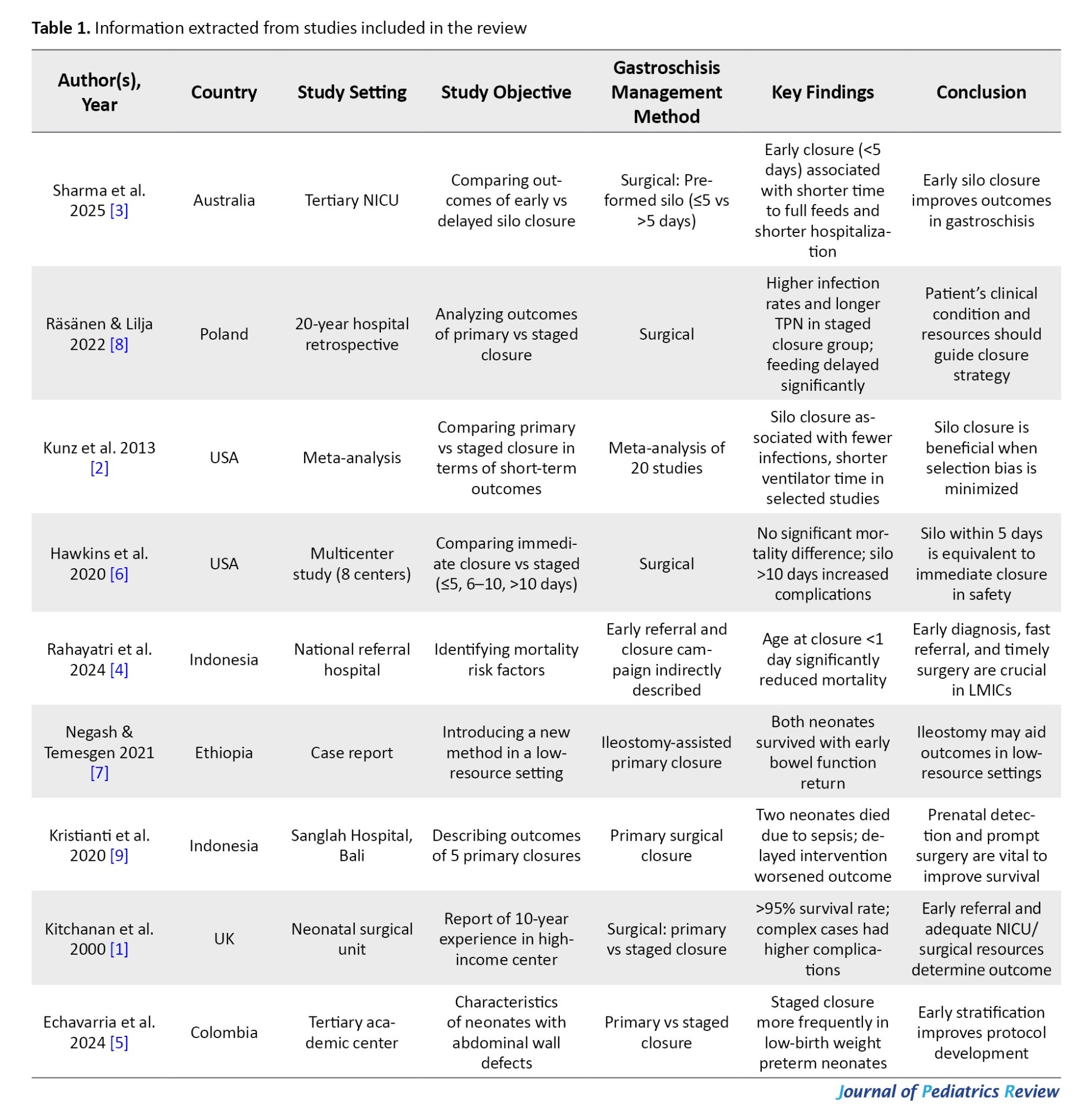
After applying the inclusion and exclusion criteria, 9 studies were finally selected for review. We used a standard data-extraction form to ensure consistency and comparability across studies. The extracted data included the authors’ name, year of publication, study country, study setting, study objectives, the gastroschisis management method (surgical or campaign), the main results or outcomes, and a final message or implication that came from the study (Table 1).
Results
The review of the selected studies gave important information about how to treat gastroschisis in different healthcare settings. They showed both progress in clinical practice and problems with the system. Even though the studies had different designs, populations, and settings, they all stressed the importance of surgery for newborns as soon as possible, especially in the first five days of life, to improve their health. Comparing data from high-income countries like the UK, Australia, and the US with data from LMICs like Indonesia, Ethiopia, and Colombia shows large differences in survival rates and complications. This is mostly because of differences in health system capacity, access to prenatal diagnostics, and how quickly surgical care is provided.
Sharma et al. [3] conducted a large-scale retrospective study in Australia on newborns with gastroschisis who were treated at a tertiary NICU to see how outcomes differed between closing the silo early (within 5 days) and late (beyond 5 days). They found that, with early closure, patients could start eating normally sooner and were in the hospital for less time. This finding shows that early surgery using phased closure approaches leads to better outcomes for newborns and should be the preferred method in the right clinical situations. Räsänen and Lilja [8] explored a 20-year experience of surgical management in Poland to see how primary and phased silo closure affected the prognosis of neonates with gastroschisis. According to their study, babies who received primary closure had shorter pain relief periods, started eating sooner, and had fewer general infections than babies who had staged closure. However, the type of surgery depended on the baby’s health and the size of their abdominal cavity. The authors suggested that there is no single best method and that personalized care remains important.
Kunz et al. [2] conducted a meta-analysis of 20 RCTs to compare the short-term effects of primary closure with staged silo closure. When selection bias was minimized, the meta-analysis showed that staged closure with silos led to fewer days on a ventilator and lower infection risk. When all of the studies were looked at together, primary closure showed slightly better results. The authors concluded that both methods have pros and cons, but selection bias strongly affects comparative outcomes; thus, more rigorous RCTs are needed.
Hawkins et al. [6] conducted a large multicenter study in the US on 566 babies with gastroschisis in eight hospitals. They were divided into two groups: immediate closure and staged closure. The staged closure group was further divided into subgroups based on how long they had been using the silo. The data showed that outcomes including death rates, sepsis rates, and the time to get complete enteral feeds were similar for both immediate and staged closure groups within five days. However, using the silo for a long time (>10 days) led to longer hospital stays and more illness. Notably, fast closure was associated with a higher rate of postoperative ventral hernias, which shows that choosing the right patients and setting the time of the closure carefully are very important for getting the best results.
Rahayatri et al. [4] provided regional statistics from the national referral hospital in Jakarta, Indonesia. Their retrospective cohort study showed a death rate of 69% in babies with gastroschisis, which is a much greater rate than that in high-income countries. They found that surgical closure done within the first 24 hours of life led to a lower risk of death. Other risk factors that seemed important, such as birth weight and gestational age, were not significant predictors. Their study highlighted the importance of identifying neonatal surgical emergencies early, having quick referral systems, and being ready to manage them in low-resource settings.
Negash and Temesgen [7] described a new surgical approach in Ethiopia that involved ileostomy-assisted primary closure. In their case report, two newborns with gastroschisis had surgery early to create an ileostomy, which helped relieve pressure on the gut and made it easier to close. Both babies lived, and their bowels worked again soon after. This new technique is especially useful in LMICs where it is hard to have access to NICUs and staged silo closure equipment. Their study found that ileostomy-assisted closure could be a good option in resource-limited areas.
Kristianti et al. [9] studied five newborns in Bali, Indonesia, who had primary closure for gastroschisis. Three newborns lived, but two died from sepsis, showing how important it is to get help quickly and have good prenatal care. The babies who were sent from remote regions without proper prenatal care or who had to wait longer to get surgery were more likely to have bad outcomes. Their study showed the importance of education for people about prenatal screening and neonatal referral systems through campaigns.
Kitchanan et al. [1] studied 132 babies with gastroschisis who were treated at a high-income tertiary care center in the UK over ten years. Their study found that more than 95% of babies who underwent surgery survived. It also showed that complicated cases of gastroschisis needed longer hospital stays and had more complications. The authors suggested that better results might be due to the availability of trained newborn surgical teams, timely interventions, and high-quality intensive care facilities. Their study highlighted the importance of centralized surgical care and good healthcare infrastructure.
Finally, a study in Colombia by Echavarria et al. [5] examined traits of newborns with abdominal wall abnormalities who needed primary or staged closure. The study indicated that neonates who needed staged closure were female, had early birth, and had low birth weight. These results suggest that some clinical factors may help predict the need for staged closure. They can also help families with planning and counseling before surgery.
Discussion
All reviewed studies showed that surgical procedures for gastroschisis have advanced and outcomes have improved in high-income countries. However, many problems remain in LMICs. Survival is strongly affected by the timing of closure, the baby’s health at birth, and systemic factors such as early detection, referral logistics, and institutional preparedness. Public health initiatives should make prenatal care more accessible, raise clinician awareness, and establish strong procedures for transporting newborns. According to the most recent research, there is no one-size-fits-all way to treat gastroschisis. Instead, treatment should be based on available resources, the severity of the condition, and each newborn’s specific needs. In the future, research should bring everyone together to reduce differences and encourage standard care methods across all health systems.
The studies showed how closely the clinical outcomes in gastroschisis are tied to the larger health system in which care is given. In high-income countries like the UK, US, and Australia, the survival rate of newborns with gastroschisis is more than 95%. These good results are not just because of new surgical techniques; they also reflect a strong care system that includes routine anomaly screening for early prenatal diagnosis, planned deliveries in tertiary centers with pediatric surgical teams, and immediate postnatal stabilization in advanced NICUs. Interdisciplinary teamwork among neonatologists, pediatric surgeons, anaesthesiologists, and neonatal nurses, all of whom follow evidence-based clinical standards and protocols for when to operate and how to care for patients after surgery, also supports these settings. These system-level enablers work together to enable faster decision-making and quicker surgery, both of which are important for reducing complications such as sepsis, delayed feeding, and longer hospital stays [1, 3]. In contrast, LMICs like Indonesia, Ethiopia, and Colombia have institutional and infrastructure problems that make it difficult to treat gastroschisis early. These include low prenatal screening coverage, lack of counseling during pregnancy, delays in referrals after birth, lack of pediatric surgical skill, and limited access to neonatal intensive care services. Because of these conditions, neonates often come to clinics late, in bad shape, with a higher risk of infections, intestinal ischemia, and fluid-electrolyte imbalances. Rahayatri et al.’s study in Indonesia found that 69% of newborns with gastroschisis died, which shows the danger of bad outcomes when closure is not done within 24 hours [4]. Negash and Temesgen (2021)’s study in Ethiopia showed how poor outcomes can be when surgical options are limited. They also showed that context-specific methods, such as ileostomy-assisted closure, can save lives when standard resources are not accessible [7]. These results strongly suggest that in LMICs, the survival of newborns with gastroschisis depends less on how complicated the surgery is and more on how ready the system is and how quickly the surgery can be done.
Taken together, these results show that the choice of surgical technique—whether primary closure or silo reduction—remains an important clinical decision, but the health system’s ability to deliver timely, safe interventions ultimately determines patient outcomes. The reviewed studies showed that the timing of closure is a key factor in recovery. Neonates that get closure, either immediately or with a silo within the first five days of life, have better enteral feeding tolerance, need less ventilator support, and stay in the hospital for a shorter time [2, 6]. Focusing on when to perform surgical closure shifts the question from “which technique is better” to “how soon can any surgical technique be safely performed?” This shift can have a big impact on policies and practice, especially in places where resources are limited and improvisation is often needed.
Also, there is a strong chance to close the gap in global surgical equity through new ideas and collaboration. The use of ileostomy-assisted closure in Ethiopia is an example of how surgical principles can be changed to fit the needs of a specific area. These low-cost, easy-to-replicate ideas should be systematically tested and shared in similar settings. At the same time, making cost-effective, sterilizable silo devices from materials that are easy to get locally can help the solution work in places where commercial silos are too expensive or hard to find. Implementing mobile health or telemedicine programs to improve prenatal monitoring, especially in rural and deprived areas, can further support these ideas. Telehealth platforms can help with proactive birth planning, faster referrals, and shorter pre-surgical delays by making it possible to find problems early and sort them by risk during pregnancy. These are all connected to better survival.
Moreover, establishing national surgical registries and standard reporting systems across hospitals, especially in LMICs, can provide useful epidemiological data to identify patterns, monitor outcomes, and inform policy changes. By comparing institutional performance, identifying delays in the care process, and highlighting successful improvements, these systems can help improve quality. Combining these data-driven methods with direct patient care can not only make care more transparent and accountable, but also encourage learning from other countries and collaboration on neonatal surgery research.
Conclusion
The review revealed a new, more complex way to think about treating gastroschisis: the best results come from a combination of good surgical decisions, system-level preparation, and situation-appropriate innovation. The debate over primary versus staged closure for treating gastroschisis is still ongoing, but the studies show that timely closure, ideally during the first five days of life, can lead to better outcomes in newborns. Of course, this benefit only works if the health system functions well and responds quickly. A hybrid approach, where surgery is done with technical perfection and everyone has equal access and the flexibility to adapt, is the best way to move forward. To improve care for newborns with gastroschisis, we need more than just technical skills. We need to invest in health infrastructure, create innovations specific to each area, and make a global commitment to closing gaps in neonatal surgery.
Ethical Considerations
Compliance with ethical guidelines
This article is a narrative review with no human or animal sample.
Funding
This research did not receive any grant from funding agencies in the public, commercial, or non-profit sectors.
Conflicts of interest
The author declared no conflict of interest.
Gastroschisis is a birth abnormality that affects the front of the abdomen and causes the intestines and other abdominal contents to push through a paraumbilical aperture without a protective barrier. The defect is usually on the right side of the umbilicus, which exposes the colon to amniotic fluid. This causes the intestines to become inflamed, thicken, and mat together. This issue is usually found before birth on ultrasound, typically in the second trimester. After birth, it needs immediate surgery to avoid serious complications such as infection, fluid loss, and hypothermia [1, 2]. Over the past few decades, the number of people with gastroschisis worldwide has been increasing. The International Clearinghouse for Birth Defects Surveillance and Research (ICBDSR) found that birth defect incidence rate varied greatly by geography. It is 3.06 per 10,000 live births globally, 1.49 per 10,000 in Europe, 3.80 per 10,000 in Latin America, and 4.32 per 10,000 in North America [3]. In low- and middle-income countries (LMICs), like Indonesia and some portions of Africa, the burden is even worse because there is not enough access to specialized neonatal surgical care. This leads to a disproportionately high death rate—up to 69% in Indonesia, for example [4].
Several factors seem to increase the risk of gastroschisis. Some patients have a mother less than 20 years old, have a low body mass index (BMI), smoke tobacco or cocaine, consume alcohol, have infections, and use medications during pregnancy [5]. Gastroschisis is not often linked to chromosomal abnormalities, unlike omphalocele. This suggests that these two conditions have different causes. It is thought that the right omphalomesenteric artery gets damaged during development, which cuts off blood flow and causes the abdominal wall to break. In the clinic, gastroschisis is very difficult to manage. It is sometimes worsened by intestinal damage, such as atresia, stenosis, perforation, and necrosis. This is especially true for a type of gastroschisis known as “complex gastroschisis.” Because of this condition, hospital admissions are longer, feeding tolerance is delayed, and the risk of infection and death is higher. In a study of 566 newborns across multiple centers, complex gastroschisis was linked to longer total parenteral nutrition (TPN), delayed enteral feeding, and greater reliance on ventilators [6]. Long-term neurodevelopmental outcomes are not always bad for survivors, but long stays in the neonatal intensive care unit (NICU), multiple surgeries, and parents’ stress have a considerable effect on families’ mental health, often causing anxiety, depression, and post-traumatic stress symptoms in caregivers [7].
There is currently no global agreement on the best surgical approach for repairing gastroschisis. Primary closure and staged closure are the two most common approaches. Primary closure, which is done soon after birth, includes quickly fixing the herniated bowel and closing the abdominal wall. Staged closure uses a pre-made silo to slowly return the bowel to the abdominal cavity over several days before closing it completely. Staged closure may lower the risk of abdominal compartment syndrome and the need for a ventilator, but delayed closure can prolong the time to full feeds and lengthen hospital stays [3, 8]. Sutureless closure techniques and hybrid procedures, such as ileostomy-assisted primary closure in resource-limited situations, are among the newest approaches. In a study that used an ileostomy, it helped the bowel function recover and was associated with better survival in a situation where the death rate was high [7]. In high-income countries, where NICUs and surgical skills are easy to access, survival rates for simple gastroschisis cases are currently over 95% [1].
To lessen the impact of gastroschisis worldwide, efforts have gone beyond improving surgery to include public health campaigns. These efforts often try to get people to understand how important prenatal care is, to stop teens from getting pregnant, and to teach people about teratogenic risk factors. However, these efforts are not always effective. In high-income countries, better outcomes come from early prenatal diagnosis and sending patients to tertiary centers while they are still in the womb, while in LMICs, socioeconomic hurdles, geographic inaccessibility, and poor health system infrastructure limit access to these services. A study in Jakarta, Indonesia, showed the importance of timely referrals and immediate surgery to lower the death rate [4].
Even with these programs, outcomes still differ. Many families in resource-limited areas still use homemade silos or delayed transfers, both of which make sepsis more likely and make the outcome worse. Therefore, in addition to educational outreach, systemic healthcare reforms are necessary to improve survival and lower the global rate of gastroschisis. These reforms include setting up regional neonatal surgery units and standardizing practices. This study reviews recent information on the epidemiology, pathophysiology, treatment, and public health measures for gastroschisis. This review can help doctors, policymakers, and researchers better understand the many challenges involved in treating gastroschisis. It will also support clinical practice and health policy development across a wide range of healthcare settings.
Materials and Methods
This literature review used a systematic method to find, analyze, and combine the available evidence on gastroschisis in newborns. It focused on clinical management options, epidemiological characteristics, and the effectiveness of public health measures. The strategy was based on conventional evidence-based medicine methods and was adapted to address the study question of health system responses and outcomes related to gastroschisis. We conducted the literature search in several well-known electronic databases, including PubMed, Scopus, ScienceDirect, Google Scholar, SpringerLink, Elsevier, and ProQuest. We used Boolean operators and Medical Subject Headings (MeSH) terms to search for relevant studies, as follows, for example: “gastroschisis” AND (“neonates” OR “newborns”) AND (“management” OR “clinical outcome” OR “surgical technique” OR “campaign” OR “intervention” OR “mortality”).
We looked only for studies published between January 2010 and July 2025 to align with current clinical practices and public health trends. We only included studies published in English with the full text available. The included studies should be about newborns with gastroschisis and give information about management results, public health responses, or epidemiological trends. Observational cohort studies, case series with at least five participants, randomized controlled trials (RCTs), and systematic reviews or meta-analyses were included. Included studies should examine specific clinical outcomes, such as death, feeding milestones, length of stay in the hospital, infection rates, or surgical complications. We also included articles on campaign-based initiatives, awareness campaigns, or health system efforts to improve neonatal surgery outcomes. On the other hand, studies that used animal models or in vitro studies, did not examine human newborns, or did not assess at least one of the predefined clinical or public health outcomes mentioned above were excluded. We did not include editorials, expert opinions, letters to the editor, conference abstracts, or publications without full texts. We also excluded studies that were published in languages other than English.
After applying the inclusion and exclusion criteria, 9 studies were finally selected for review. We used a standard data-extraction form to ensure consistency and comparability across studies. The extracted data included the authors’ name, year of publication, study country, study setting, study objectives, the gastroschisis management method (surgical or campaign), the main results or outcomes, and a final message or implication that came from the study (Table 1).
Results
The review of the selected studies gave important information about how to treat gastroschisis in different healthcare settings. They showed both progress in clinical practice and problems with the system. Even though the studies had different designs, populations, and settings, they all stressed the importance of surgery for newborns as soon as possible, especially in the first five days of life, to improve their health. Comparing data from high-income countries like the UK, Australia, and the US with data from LMICs like Indonesia, Ethiopia, and Colombia shows large differences in survival rates and complications. This is mostly because of differences in health system capacity, access to prenatal diagnostics, and how quickly surgical care is provided.
Sharma et al. [3] conducted a large-scale retrospective study in Australia on newborns with gastroschisis who were treated at a tertiary NICU to see how outcomes differed between closing the silo early (within 5 days) and late (beyond 5 days). They found that, with early closure, patients could start eating normally sooner and were in the hospital for less time. This finding shows that early surgery using phased closure approaches leads to better outcomes for newborns and should be the preferred method in the right clinical situations. Räsänen and Lilja [8] explored a 20-year experience of surgical management in Poland to see how primary and phased silo closure affected the prognosis of neonates with gastroschisis. According to their study, babies who received primary closure had shorter pain relief periods, started eating sooner, and had fewer general infections than babies who had staged closure. However, the type of surgery depended on the baby’s health and the size of their abdominal cavity. The authors suggested that there is no single best method and that personalized care remains important.
Kunz et al. [2] conducted a meta-analysis of 20 RCTs to compare the short-term effects of primary closure with staged silo closure. When selection bias was minimized, the meta-analysis showed that staged closure with silos led to fewer days on a ventilator and lower infection risk. When all of the studies were looked at together, primary closure showed slightly better results. The authors concluded that both methods have pros and cons, but selection bias strongly affects comparative outcomes; thus, more rigorous RCTs are needed.
Hawkins et al. [6] conducted a large multicenter study in the US on 566 babies with gastroschisis in eight hospitals. They were divided into two groups: immediate closure and staged closure. The staged closure group was further divided into subgroups based on how long they had been using the silo. The data showed that outcomes including death rates, sepsis rates, and the time to get complete enteral feeds were similar for both immediate and staged closure groups within five days. However, using the silo for a long time (>10 days) led to longer hospital stays and more illness. Notably, fast closure was associated with a higher rate of postoperative ventral hernias, which shows that choosing the right patients and setting the time of the closure carefully are very important for getting the best results.
Rahayatri et al. [4] provided regional statistics from the national referral hospital in Jakarta, Indonesia. Their retrospective cohort study showed a death rate of 69% in babies with gastroschisis, which is a much greater rate than that in high-income countries. They found that surgical closure done within the first 24 hours of life led to a lower risk of death. Other risk factors that seemed important, such as birth weight and gestational age, were not significant predictors. Their study highlighted the importance of identifying neonatal surgical emergencies early, having quick referral systems, and being ready to manage them in low-resource settings.
Negash and Temesgen [7] described a new surgical approach in Ethiopia that involved ileostomy-assisted primary closure. In their case report, two newborns with gastroschisis had surgery early to create an ileostomy, which helped relieve pressure on the gut and made it easier to close. Both babies lived, and their bowels worked again soon after. This new technique is especially useful in LMICs where it is hard to have access to NICUs and staged silo closure equipment. Their study found that ileostomy-assisted closure could be a good option in resource-limited areas.
Kristianti et al. [9] studied five newborns in Bali, Indonesia, who had primary closure for gastroschisis. Three newborns lived, but two died from sepsis, showing how important it is to get help quickly and have good prenatal care. The babies who were sent from remote regions without proper prenatal care or who had to wait longer to get surgery were more likely to have bad outcomes. Their study showed the importance of education for people about prenatal screening and neonatal referral systems through campaigns.
Kitchanan et al. [1] studied 132 babies with gastroschisis who were treated at a high-income tertiary care center in the UK over ten years. Their study found that more than 95% of babies who underwent surgery survived. It also showed that complicated cases of gastroschisis needed longer hospital stays and had more complications. The authors suggested that better results might be due to the availability of trained newborn surgical teams, timely interventions, and high-quality intensive care facilities. Their study highlighted the importance of centralized surgical care and good healthcare infrastructure.
Finally, a study in Colombia by Echavarria et al. [5] examined traits of newborns with abdominal wall abnormalities who needed primary or staged closure. The study indicated that neonates who needed staged closure were female, had early birth, and had low birth weight. These results suggest that some clinical factors may help predict the need for staged closure. They can also help families with planning and counseling before surgery.
Discussion
All reviewed studies showed that surgical procedures for gastroschisis have advanced and outcomes have improved in high-income countries. However, many problems remain in LMICs. Survival is strongly affected by the timing of closure, the baby’s health at birth, and systemic factors such as early detection, referral logistics, and institutional preparedness. Public health initiatives should make prenatal care more accessible, raise clinician awareness, and establish strong procedures for transporting newborns. According to the most recent research, there is no one-size-fits-all way to treat gastroschisis. Instead, treatment should be based on available resources, the severity of the condition, and each newborn’s specific needs. In the future, research should bring everyone together to reduce differences and encourage standard care methods across all health systems.
The studies showed how closely the clinical outcomes in gastroschisis are tied to the larger health system in which care is given. In high-income countries like the UK, US, and Australia, the survival rate of newborns with gastroschisis is more than 95%. These good results are not just because of new surgical techniques; they also reflect a strong care system that includes routine anomaly screening for early prenatal diagnosis, planned deliveries in tertiary centers with pediatric surgical teams, and immediate postnatal stabilization in advanced NICUs. Interdisciplinary teamwork among neonatologists, pediatric surgeons, anaesthesiologists, and neonatal nurses, all of whom follow evidence-based clinical standards and protocols for when to operate and how to care for patients after surgery, also supports these settings. These system-level enablers work together to enable faster decision-making and quicker surgery, both of which are important for reducing complications such as sepsis, delayed feeding, and longer hospital stays [1, 3]. In contrast, LMICs like Indonesia, Ethiopia, and Colombia have institutional and infrastructure problems that make it difficult to treat gastroschisis early. These include low prenatal screening coverage, lack of counseling during pregnancy, delays in referrals after birth, lack of pediatric surgical skill, and limited access to neonatal intensive care services. Because of these conditions, neonates often come to clinics late, in bad shape, with a higher risk of infections, intestinal ischemia, and fluid-electrolyte imbalances. Rahayatri et al.’s study in Indonesia found that 69% of newborns with gastroschisis died, which shows the danger of bad outcomes when closure is not done within 24 hours [4]. Negash and Temesgen (2021)’s study in Ethiopia showed how poor outcomes can be when surgical options are limited. They also showed that context-specific methods, such as ileostomy-assisted closure, can save lives when standard resources are not accessible [7]. These results strongly suggest that in LMICs, the survival of newborns with gastroschisis depends less on how complicated the surgery is and more on how ready the system is and how quickly the surgery can be done.
Taken together, these results show that the choice of surgical technique—whether primary closure or silo reduction—remains an important clinical decision, but the health system’s ability to deliver timely, safe interventions ultimately determines patient outcomes. The reviewed studies showed that the timing of closure is a key factor in recovery. Neonates that get closure, either immediately or with a silo within the first five days of life, have better enteral feeding tolerance, need less ventilator support, and stay in the hospital for a shorter time [2, 6]. Focusing on when to perform surgical closure shifts the question from “which technique is better” to “how soon can any surgical technique be safely performed?” This shift can have a big impact on policies and practice, especially in places where resources are limited and improvisation is often needed.
Also, there is a strong chance to close the gap in global surgical equity through new ideas and collaboration. The use of ileostomy-assisted closure in Ethiopia is an example of how surgical principles can be changed to fit the needs of a specific area. These low-cost, easy-to-replicate ideas should be systematically tested and shared in similar settings. At the same time, making cost-effective, sterilizable silo devices from materials that are easy to get locally can help the solution work in places where commercial silos are too expensive or hard to find. Implementing mobile health or telemedicine programs to improve prenatal monitoring, especially in rural and deprived areas, can further support these ideas. Telehealth platforms can help with proactive birth planning, faster referrals, and shorter pre-surgical delays by making it possible to find problems early and sort them by risk during pregnancy. These are all connected to better survival.
Moreover, establishing national surgical registries and standard reporting systems across hospitals, especially in LMICs, can provide useful epidemiological data to identify patterns, monitor outcomes, and inform policy changes. By comparing institutional performance, identifying delays in the care process, and highlighting successful improvements, these systems can help improve quality. Combining these data-driven methods with direct patient care can not only make care more transparent and accountable, but also encourage learning from other countries and collaboration on neonatal surgery research.
Conclusion
The review revealed a new, more complex way to think about treating gastroschisis: the best results come from a combination of good surgical decisions, system-level preparation, and situation-appropriate innovation. The debate over primary versus staged closure for treating gastroschisis is still ongoing, but the studies show that timely closure, ideally during the first five days of life, can lead to better outcomes in newborns. Of course, this benefit only works if the health system functions well and responds quickly. A hybrid approach, where surgery is done with technical perfection and everyone has equal access and the flexibility to adapt, is the best way to move forward. To improve care for newborns with gastroschisis, we need more than just technical skills. We need to invest in health infrastructure, create innovations specific to each area, and make a global commitment to closing gaps in neonatal surgery.
Ethical Considerations
Compliance with ethical guidelines
This article is a narrative review with no human or animal sample.
Funding
This research did not receive any grant from funding agencies in the public, commercial, or non-profit sectors.
Conflicts of interest
The author declared no conflict of interest.
References
- Kitchanan S, Patole SK, Muller R, Whitehall JS. Neonatal outcome of gastroschisis and exomphalos: a 10-year review. J Paediatr Child Health. 2000; 36(5):428-30. [DOI:10.1046/j.1440-1754.2000.00551.x] [PMID]
- Kunz SN, Tieder JS, Whitlock K, Jackson JC, Avansino JR. Primary fascial closure versus staged closure with silo in patients with gastroschisis: a meta-analysis. J Pediatr Surg. 2013; 48(4):845-57. [DOI:10.1016/j.jpedsurg.2013.01.020] [PMID]
- Sharma P, Gera P, Rao S. Early versus delayed silo closure in gastroschisis: A retrospective study. Pediatr Surg Int. 2025; 41(1):138. [DOI: 10.1007/s00383-025-06042-6] [PMID]
- Rahayatri TH, Gunardi HD, Amin RB, Tamba RP. Gastroschisis survival improvement and early intervention: experience in a developing country. Paediatrica Indonesiana (Paediatrica Indonesiana). 2024; 64(3):263-69. [Link]
- Echavarria AM, Torres Trujillo LE, Zapata Cadavid AM, Turbay Botero A, Echavarría Restrepo S. Characterization of neonates with abdominal wall defects and primary surgical closure. Neonatal. 2024; 5(2):19. [DOI:10.35702/neo.10019]
- Hawkins RB, Raymond SL, St Peter SD, Downard CD, Qureshi FG, Renaud E, Danielson PD, Islam S. Immediate versus silo closure for gastroschisis: Results of a large multicenter study. J Pediatr Surg. 2020; 55(7):1280-5. [DOI:10.1016/j.jpedsurg] [PMID]
- Negash T, Temesgen G. Ileostomy-assisted primary closure for gastroschisis in a low-resource setting: A case report. J. Pediatr. Surg. Case Rep. 2021; 76: 102135. [DOI: 10.1016/j.epsc.2021.102135]
- Räsänen L, Lilja HE. Outcome and management in neonates with gastroschisis in the third millennium: a single-centreobservational study. Eur J Pediatr. 2022;181:2291-2298. [DOI:10.1007/s00431-022-04416-9] [PMID]
- Kristianti NGH, Artana IWD, Kardana IM, Putra PJ, Sukmawati M, Ariyanta KD, et al. Gastroschisis: Five cases after primary closure at Sanglah General hospital, Bali, Indonesia. Intisari Sains Medis. 2020; 11(3):1302-7. [DOI:10.15562/ism.v11i3.730]
Type of Study: Narrative Review |
Subject:
Pediatric Surgery
Received: 2025/11/24 | Accepted: 2026/09/19 | Published: 2026/09/19
Received: 2025/11/24 | Accepted: 2026/09/19 | Published: 2026/09/19
Send email to the article author
| Rights and permissions | |
 |
This work is licensed under a Creative Commons Attribution-NonCommercial 4.0 International License. |

Copyright © The Author(s);
This is an open access article distributed under the terms of the Creative Commons Attribution License (CC-By-NC),
which permits use, distribution, and reproduction in any medium, provided the original work is properly cited and is not used for commercial purposes.
Contact Information